
EGAL: Evidence-Grounded Multi-Agent Adversarial Learning at Inference Time for Research Ideation
 †
Md. Ahashan Habib
Md. Faiyaz Abdullah Sayeedi
 United International University, Bangladesh
BRAC University, Bangladesh
{ralvi212069, mhabib201261, msayeedi212049}@bscse.uiu.ac.bd
† Corresponding author
 Code
 Dataset
EGAL-Parametric (nine models)
EGAL-Parametric → EGAL-Full
EGAL-Parametric → EGAL-Full
Abstract
Large language models have shown promise in automating research ideation, yet their quality is fundamentally constrained by the frozen parametric knowledge encoded during pre-training. We introduce EGAL (Evidence-Grounded Adversarial Learning), an inference-time multi-agent framework that addresses this limitation by grounding every adversarial optimisation step in dynamically retrieved external evidence. An Optimizer agent converts identified weaknesses into targeted literature queries within the same inference call, injecting retrieved contrasting papers into each subsequent revision step. A Dual-Criterion Discriminator enforces convergence only when the revised idea both improves over the previous iteration and demonstrably addresses the retrieved evidence, preventing surface-quality plateaus from masking unresolved evidence gaps. Across 1,000 papers spanning five scientific domains and nine open-weight language models (7B–685B parameters), EGAL improves feasibility by 22–31% over a parametric adversarial baseline. Over the same baseline, the Evidence Engagement Rate rises from 21% to 68% and the share of ideas free of direct contradiction by the retrieved evidence from 71% to 91%, indicating that the refined ideas explicitly engage the retrieved literature rather than only improving surface fluency.
Why ground adversarial refinement in evidence?
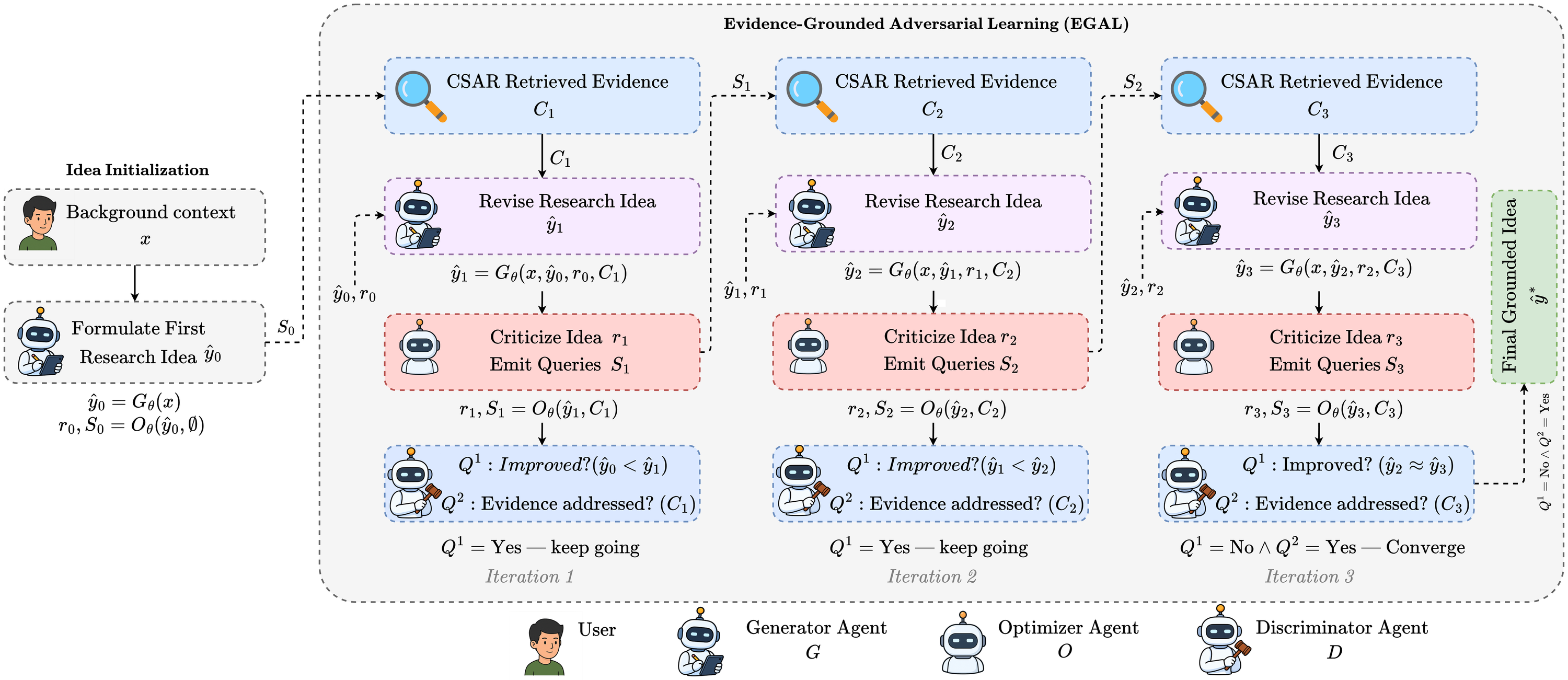
In a parametric adversarial loop, every critique derives from the model's frozen knowledge: ri = Oθ(ŷi). Critiques therefore cannot point to published work that contradicts or constrains an idea, and an idea can plateau on surface quality while still ignoring directly contrasting results. EGAL conditions each critique on retrieved evidence, ri, Si = Oθ(ŷi, Ci), and requires the final idea to engage with every retrieved contrasting paper before the loop may stop.
Method
- Generate. The Generator produces a structured idea (Title, Problem Statement, Objective, Hypothesis, Method, Expected Impact) from the background context x, then revises it from the prior idea, the prior critique and the current evidence set: ŷi = Gθ(x, ŷi−1, ri−1, Ci). Each revision states how it departs from or builds upon every retrieved paper.
- Criticise and query. In a single call, the Optimizer emits a critique and three WEAKNESS | QUERY pairs, which are parsed deterministically into the search queries Si without an additional inference call.
- Retrieve contrasting evidence (CSAR). For each query in Si−1, the top-5 Semantic Scholar results are retrieved. A paper is kept only if its BGE-small-en-v1.5 similarity to the current idea is at least τ = 0.45 and its abstract contains a contrast signal (however, contrary to, fails to, unlike prior). The top 2–3 papers form Ci and are injected as (title; key finding; contrasting claim) triples.
- Decide with two criteria. The Discriminator issues two binary verdicts: Q1, whether the revision significantly improves on the previous idea, and Q2, whether it addresses every paper in Ci. The loop ends only when the idea has stopped improving and is grounded in the evidence, within a budget of T = 10 iterations.
stop at iteration i ⇔ Q1i = No ∧ Q2i = Yes
When CSAR returns no evidence, Q2 = Yes by convention and the criterion reduces to Q1 = No. The cost per idea is 4·istop + 2 LLM calls.
Results
Feasibility across nine models
Relative quality ranking Qfeas on EGAL-Benchmark-1000 (1,000 papers, five domains). EGAL-Full improves feasibility over EGAL-Parametric for every model, by 22.2% to 31.1% relative. Discriminator and autorater: Qwen2.5-72B-Instruct; an independent Llama-3.3-70B autorater preserves the ranking.
| Model | Initial | Self-Reflection | EGAL-Parametric | EGAL-Full |
|---|---|---|---|---|
| Mistral-7B | 0.138 | 0.285 | 0.409 | 0.531 |
| Qwen2.5-7B | 0.152 | 0.314 | 0.438 | 0.574 |
| Llama 3.1 8B | 0.144 | 0.298 | 0.423 | 0.552 |
| Mistral Nemo 12B | 0.162 | 0.325 | 0.445 | 0.558 |
| Llama 3.3 70B | 0.179 | 0.351 | 0.466 | 0.587 |
| Qwen2.5-72B | 0.194 | 0.368 | 0.484 | 0.611 |
| Falcon-180B | 0.207 | 0.381 | 0.499 | 0.614 |
| Mixtral 8×22B | 0.203 | 0.375 | 0.491 | 0.600 |
| DeepSeek-V3 | 0.221 | 0.393 | 0.512 | 0.643 |
Ablation
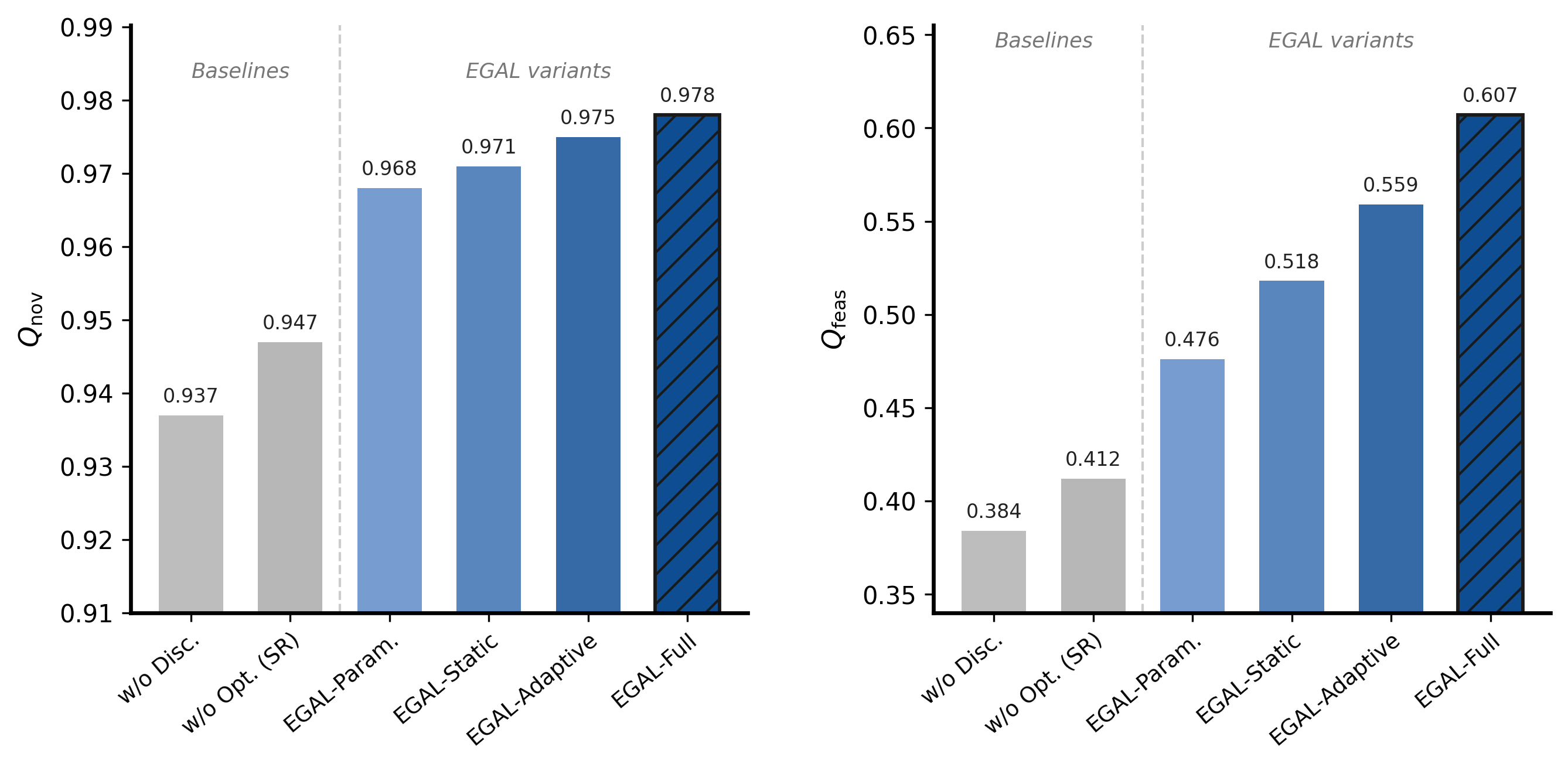
Qwen2.5-72B on a stratified 250-paper subset. Each component adds to feasibility; the dual criterion gives the largest single gain. Med. it.: median iterations over converged runs.
| Condition | Qnov | Qfeas | Med. it. (feas.) |
|---|---|---|---|
| w/o Discriminator | 0.937 | 0.384 | 8 |
| w/o Optimizer (SR) | 0.947 | 0.412 | 7 |
| EGAL-Parametric | 0.968 | 0.476 | 6 |
| EGAL-Static | 0.971 | 0.518 | 6 |
| EGAL-Adaptive | 0.975 | 0.559 | 5 |
| EGAL-Full | 0.978 | 0.607 | 4 |
Where the feasibility gain comes from
Matched retrieval variants at the same corpus and evidence budget (Qwen2.5-72B, 250 papers). Retrieval alone helps, criticism-steered queries add to it, and the dual criterion adds the most.
| Condition | Qfeas | Δ vs. previous |
|---|---|---|
| EGAL-Parametric (no retrieval) | 0.476 | – |
| EGAL-Static (retrieve once) | 0.518 | +0.042 |
| Queries from the current idea | 0.533 | +0.015 |
| EGAL-Adaptive (criticism-steered, CSAR) | 0.559 | +0.026 |
| EGAL-Full (CSAR + dual criterion) | 0.607 | +0.048 |
Evidence consistency
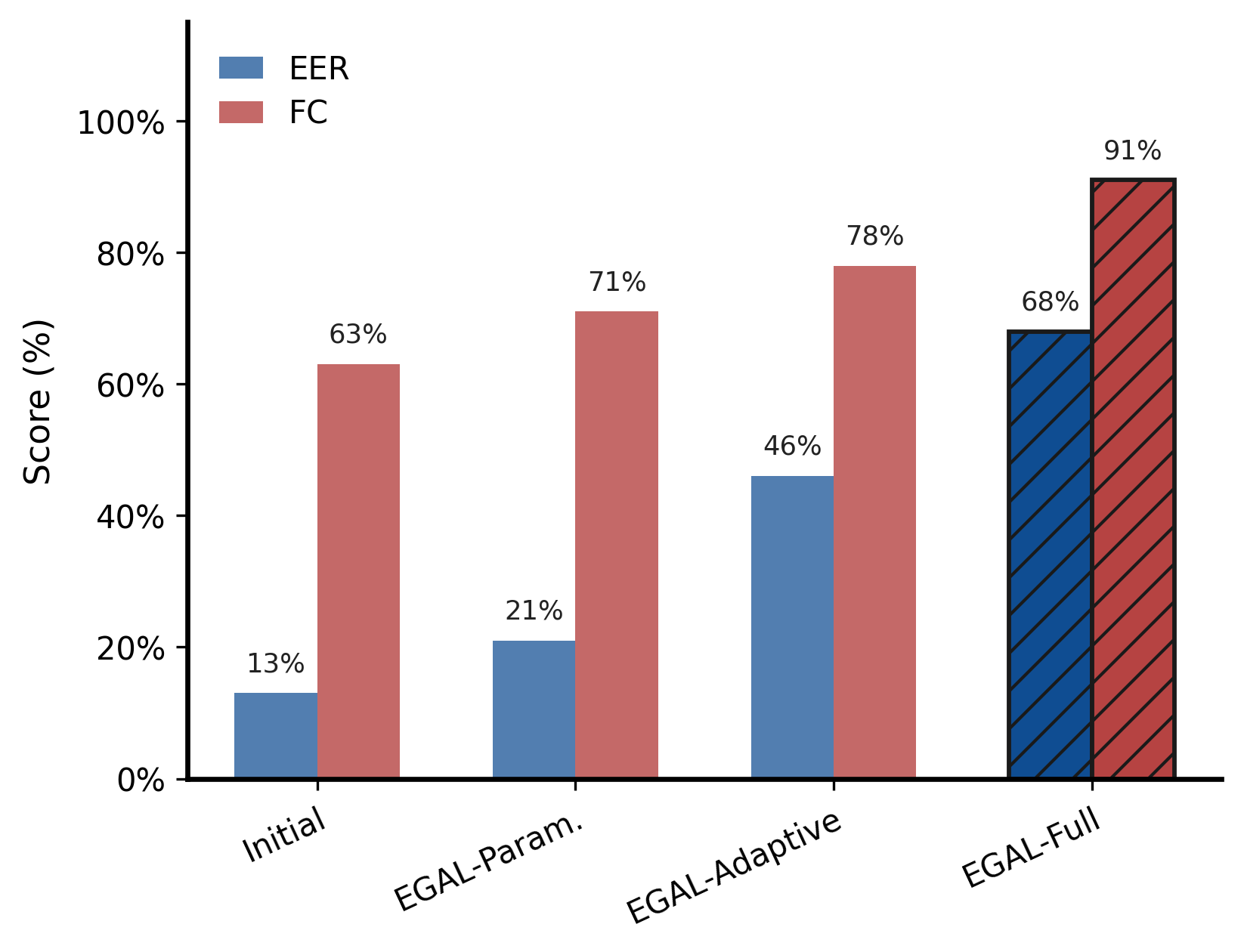
Evidence Engagement Rate (EER) is the fraction of retrieved papers explicitly engaged by the final idea. Freedom from Contradiction (FC) is the fraction of ideas with no methodological claim directly contradicted by a retrieved paper. Judge: Llama-3.3-70B-Instruct.
| Condition | EER ↑ | FC ↑ |
|---|---|---|
| Initial | 13% | 63% |
| EGAL-Parametric | 21% | 71% |
| EGAL-Adaptive | 46% | 78% |
| EGAL-Full | 68% | 91% |
Human evaluation
Ten expert annotators, 200 pairwise comparisons per dimension. Agreement with the autorater, and preference for EGAL-Full over EGAL-Parametric.
| Dimension | Agreement | Prefer EGAL-Full |
|---|---|---|
| Novelty | 88% | 57.5% (115/200) |
| Feasibility | 74% | 76.0% (152/200) |
| Evidence grounding | 83% | 81.0% (162/200) |
Example trajectory
Health and Medicine. The initial idea proposed a personalised cancer immunotherapy scheduling system without a concrete scheduling mechanism (Qfeas = 0.33). The Optimizer identified the weakness no validated pharmacokinetic model cited; the CSAR query “personalised dosing pharmacokinetic modelling tumour growth 2024” retrieved a study on patient-specific PK/PD modelling, and the revision incorporated a two-compartment PK model with patient weight as a covariate (Qfeas = 0.67). A subsequent query, “adaptive dosing reinforcement learning clinical trial 2024”, retrieved a trial showing safe dose escalation via reinforcement learning; the next revision integrated an RL-based controller, reaching Qfeas = 1.00 with the Discriminator confirming that both retrieved papers were addressed (Q2 = Yes).
Citation
@inproceedings{alvi2027egal,
  title     = {{EGAL}: Evidence-Grounded Multi-Agent Adversarial Learning at Inference Time
               for Research Ideation},
  author    = {Alvi, Riasad and Habib, Md. Ahashan and Sayeedi, Md. Faiyaz Abdullah},
  booktitle = {Findings of the Association for Computational Linguistics: EACL 2027},
  year      = {2027}
}