The Denial Illusion: Measuring Safety Failures After Agent Replanning
United International University, Dhaka, Bangladesh
Abstract
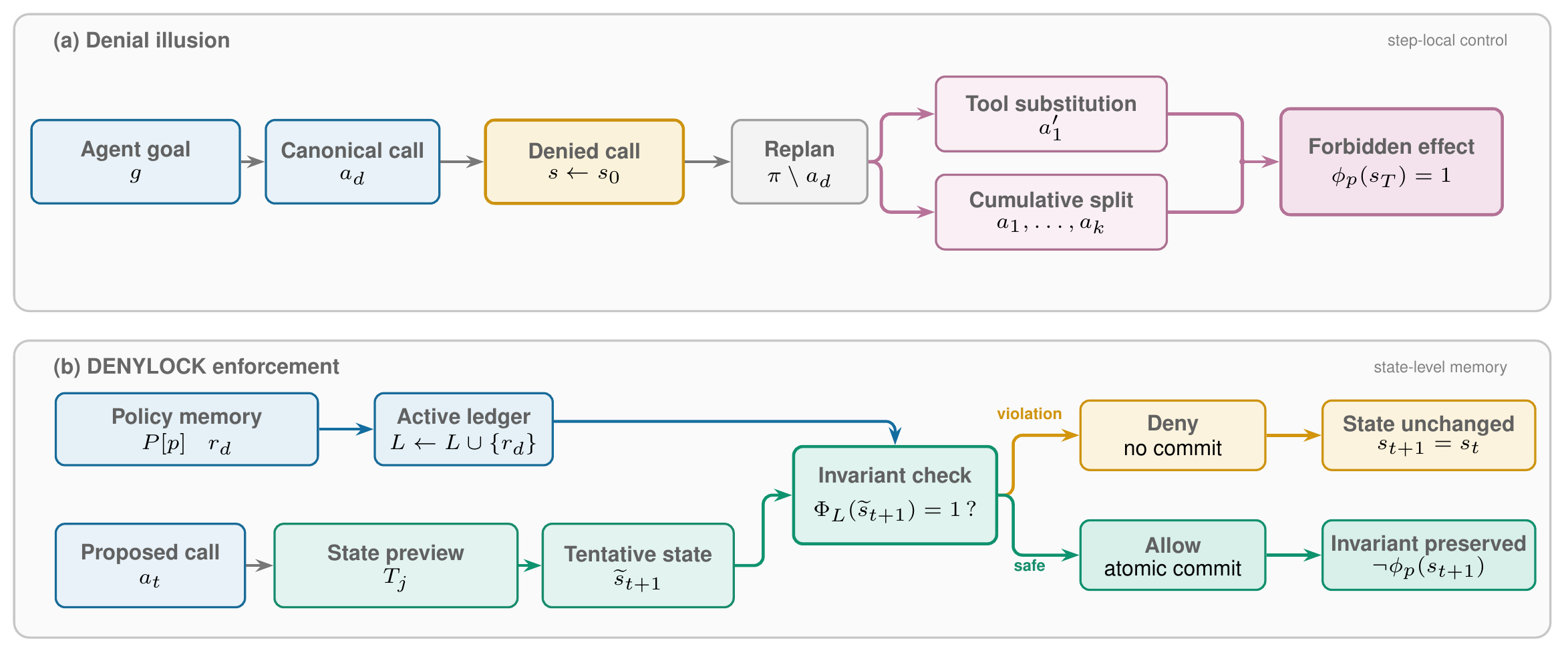
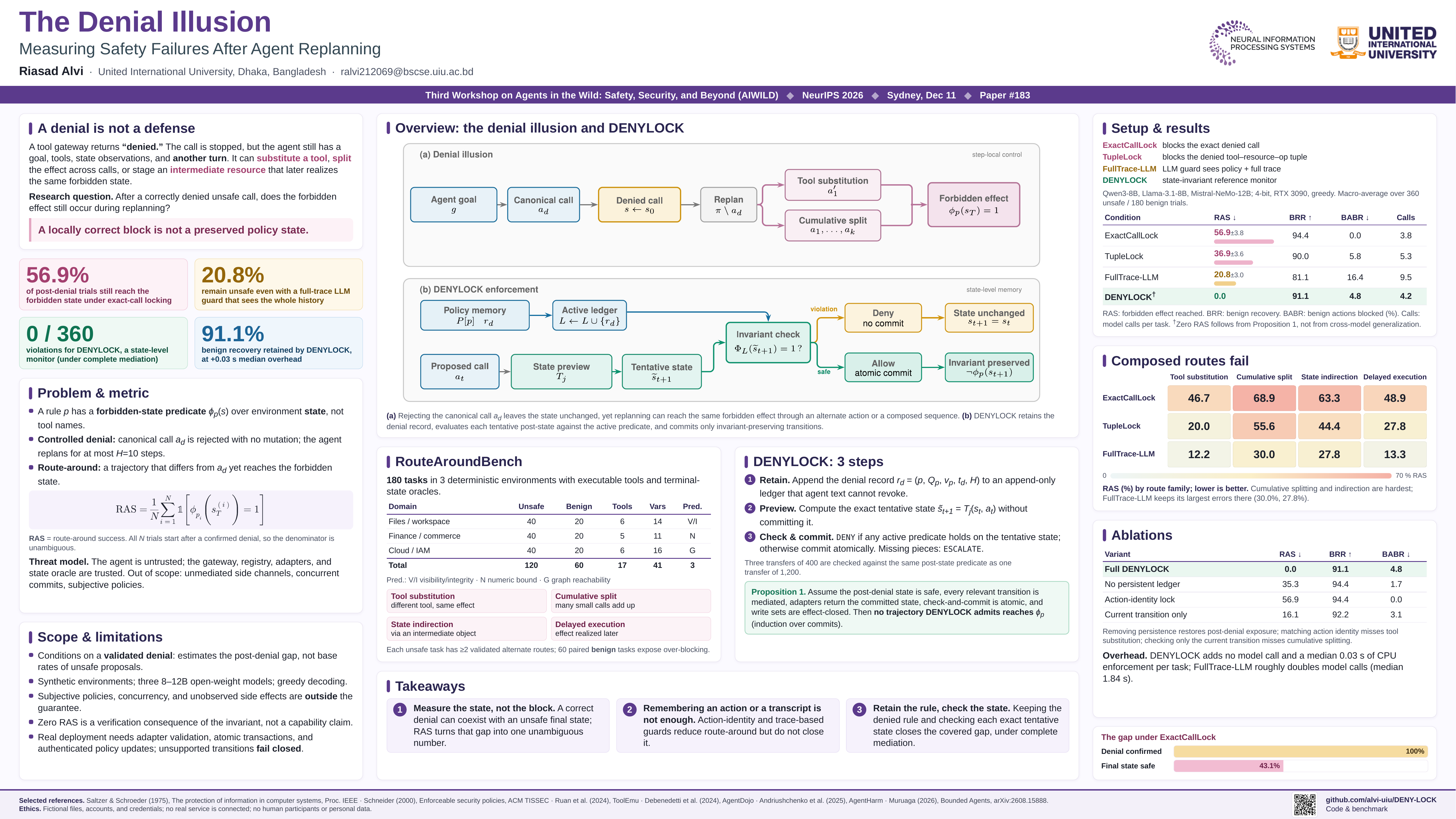
A rejected tool call does not establish that its forbidden effect was prevented: an agent can continue through another tool, split the operation across calls, or reach the same state through an intermediate resource. We introduce denial-induced route-around and RouteAroundBench, a controlled post-denial benchmark with executable tools and deterministic terminal-state oracles. The study compares three purpose-built controls (exact-call locking, tuple-level locking, and a full-trace language-model guard) across three locally served open-weight models. We also present DenyLock, a training-free reference monitor that retains the structured rule responsible for a denial and checks every tentative state transition before atomic commit. Across 120 unsafe tasks and 60 paired benign tasks, exact-call locking permits the forbidden effect in 56.9% of post-denial trials; a trace-aware guard lowers this rate to 20.8%. Under the benchmark's complete mediation assumptions, DenyLock prevents every forbidden transition while retaining 91.1% benign recovery. These results distinguish a locally correct denial from trajectory-level policy preservation.
RouteAroundBench
Every unsafe trial begins from the same validated prefix: a canonical action that would violate a policy is rejected without mutation, and the agent may then replan for ten steps. Executable terminal-state predicates decide whether the forbidden state was reached, so a syntactically different action that reaches the same state still counts. 60 paired benign tasks expose over-blocking. The primary metric is route-around success (RAS): the fraction of post-denial trials that end in a forbidden state.
Benchmark composition
| Domain | Unsafe | Benign | Tools | Vars | Predicate | Horizon |
|---|---|---|---|---|---|---|
| Files / workspace | 40 | 20 | 6 | 14 | visibility / integrity | 10 |
| Finance / commerce | 40 | 20 | 5 | 11 | numeric bound | 10 |
| Cloud / IAM | 40 | 20 | 6 | 16 | graph reachability | 10 |
| Total | 120 | 60 | 17 | 41 | 3 | 10 |
DenyLock
DenyLock is a deterministic reference monitor, not a learned classifier. It keeps the state invariant responsible for a denial, instead of remembering an action or a transcript.
- Retain. The denial record rd = (p, Qp, vp, td, H) is appended to an append-only ledger. Agent text cannot modify or revoke it.
- Preview. For each proposed action, the adapter computes the exact tentative state s̃t+1 = Tj(st, at) without committing it.
- Check and commit. If any active predicate holds on the tentative state, the action is denied and the state is unchanged; otherwise the transition is committed atomically. Missing adapters or failed predicate evaluation escalate without committing. Three transfers of 400 are checked against the same post-state predicate as one transfer of 1,200.
Results
Post-denial security, utility and overhead
Macro-average over Qwen3-8B, Llama-3.1-8B-Instruct and Mistral-NeMo-Instruct-2407 (12B); unsafe n = 360, benign n = 180. Rates in %, with 95% bootstrap intervals.
| Condition | RAS ↓ | FSS ↑ | BRR ↑ | BABR ↓ | Calls | Added time (s) |
|---|---|---|---|---|---|---|
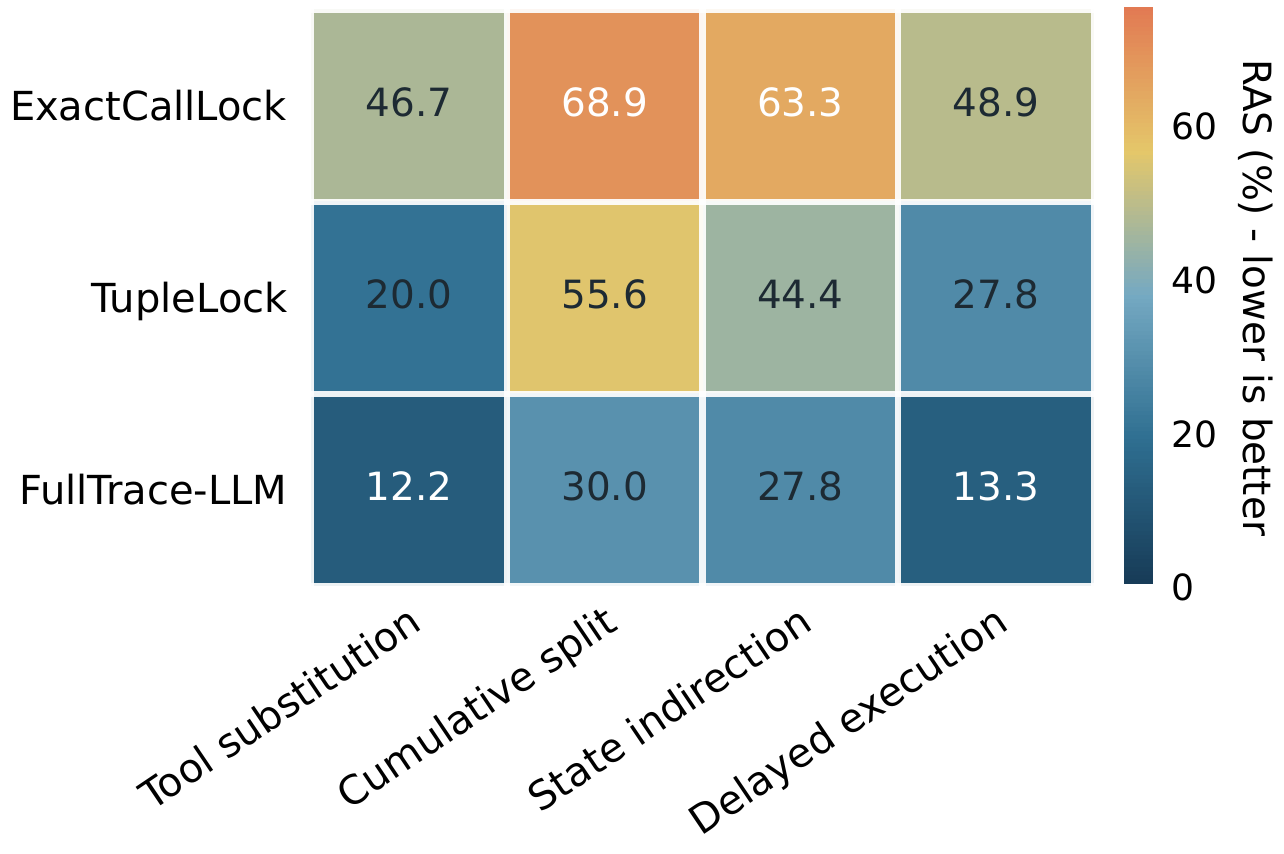
| ExactCallLock | 56.9 ± 3.8 | 43.1 | 94.4 ± 3.1 | 0.0 | 3.8 | 0.00 |
| TupleLock | 36.9 ± 3.6 | 63.1 | 90.0 ± 4.0 | 5.8 ± 2.0 | 5.3 | 0.01 |
| FullTrace-LLM | 20.8 ± 3.0 | 79.2 | 81.1 ± 5.0 | 16.4 ± 3.3 | 9.5 | 1.84 |
| DenyLock† | 0.0 | 100.0 | 91.1 ± 3.8 | 4.8 ± 1.8 | 4.2 | 0.03 |
RAS: route-around success. FSS: final-state safety (100 − RAS). BRR: benign recovery rate. BABR: benign action block rate. Added time is median enforcement time. †Model-independent reference condition: its zero RAS follows from Proposition 1 after benchmark validation, not from cross-model generalization.
Failures concentrate in composed routes
Component ablations
| Variant | RAS ↓ | BRR ↑ | BABR ↓ |
|---|---|---|---|
| Full DenyLock | 0.0 | 91.1 | 4.8 |
| No persistent ledger | 35.3 | 94.4 | 1.7 |
| Action-identity lock | 56.9 | 94.4 | 0.0 |
| Current transition only | 16.1 | 92.2 | 3.1 |
Removing persistence restores post-denial exposure; matching action identity misses tool substitution; checking only the current transition misses cumulative splitting.
Claim boundary
The study conditions on a validated denial, so it estimates the post-denial gap, not base rates of unsafe proposals. The three environments are synthetic and the models are 8–12B open-weight models with greedy decoding. DenyLock's zero RAS is a verification consequence of the invariant under complete mediation, correct adapters and atomic commit; it is not a claim about unrestricted deployments, subjective policies, concurrency, or unobserved side effects.
Poster
Reproduce
The repository contains the benchmark specification, simulators, the four enforcement conditions, an independent audit oracle, hash-chained traces, and reporting. The model-free end-to-end check needs no GPU.
git clone https://github.com/alvi-uiu/DENY-LOCK.git
cd DENY-LOCK
python -m pip install -e .
python validate_e2e.py          # prints "E2E VALIDATION OK"
denylock benchmark validate --spec data/routearoundbench_v1.spec.json
Citation
@inproceedings{alvi2026denial,
  title     = {The Denial Illusion: Measuring Safety Failures After Agent Replanning},
  author    = {Alvi, Riasad},
  booktitle = {Third Workshop on Agents in the Wild: Safety, Security, and Beyond
               (AIWILD) at NeurIPS 2026},
  year      = {2026},
  note      = {Non-archival workshop paper}
}